*****Please Visit My Youtube Channel ComputerTechies_Rstvarthi for Engineering Entertainment Educational Filmy shorts.*****
Society: A society can be defined as a group of people who have interactions within a common territory and share a similar culture.
Social Group: Social group is the coming together of two or more people who interact and further identify with one another.
Territory: Every country owns formal boundaries and territory (areas) that the world recognizes as belonging to the respective country. But a society’s boundaries don’t necessarily have to be only geographical borders.
Indian society:
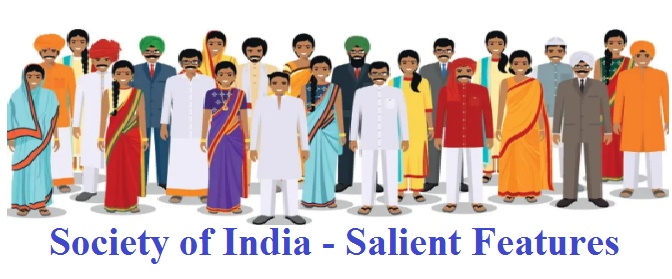
Indian society is so unique from any other in the world is its feature of Unity in Diversity. Unity in Diversity is the celebration of one- ness the citizens of India enjoy irrespective of their vast culture, geographical, ethnic and social differences. This is India’s motto and it fuels the human interaction within the nation. Unity in Diversity is the best examaple for the citizens of India and identify themselves as India in the midst of such significant differences.
Accommodation without assimilation is a key feature of our society. Over the years, India has welcomed and interacted with various elements of society without making any of these elements lose its authenticity and roots. Every individual in India enjoys the freedom to practice his or her chosen way of life.
Social structure is the distinctive human beings in a society interact and live together. Social structure is often treated together with the concept of social change, which deals with the forces that change the social structure and organization of society
Definition of Society by various Sociologists:
Giddings: “Society is the union itself, the a of formal relations in which associating individuals are bound together”.
Ginsberg: “A society is a collection of individuals united by certain relations or modes of behavior which mark them off from others who do not enter into these relations or who differ from them in behavior”.
Lapiere: “The term society refers not to a group of people, but to the complex pattern of the norms of inter- action, which arise among and between them”.
Cooley: “Society is a complex of forms or process- es each of which is living and growing by interaction with the other, the whole being so unified that what takes place in one part affects all the rest.
Adam Smith: Society is an artificial device of Natural Economy.
Salient features of the Indian society
Unity in Diversity of Society:
Indian society has challenged the skepticism of many political thinkers post inde- pendence that were doubtful regarding India’s amalgamation as one nation amidst vast differ- ences and big numbers of ethic groups, languages, culture and diversity. People visits various places to know their culture and traditions.
The core values in the constitution, the reorganization by the state on the basis of language as well as the efforts of the gov- ernment to protect the interests of minorities has helped in keeping up this unity.. Inter state migration is another feature.
Class and caste divide of Society:
In India the modern caste system is the result of the ageold varna system. The emerging class system though closely resembles the caste hierarchy it has also provided downtrodden sections an opportunity for upward social mobility.
Co-existence through inter-caste marriages and endogamy are examples for this. The divide is evident in the economic structures such as poverty, education, income, asset owner- ship, trades and professions etc. Economic reforms have led to flourishment of urban areas. Here people are categorized based on class such as income rather than their social identity.
Syncretic and Dynamic of Society:
In general, we know that, Indian society promotes accommodation as well as assimilation. Multiple tribes have lost their core indigenous culture due to assimilation into the major population of Indian society. Such contacts with different cultures also gave birth to newer practices. The society is dynamic as it is changing everyday.
Largely Agrarian and Rural of Society:
Most of the population of India, Agriculture remains the sole source of livelihood. Agrarian festivals celebrate the harvest of the crops and are celebrated in the form of Holi, Lohri, Onam, Sankranti etc. Many rural art forms like Madhubani (Bihar), fabric weaves like Khadi, and handicrafts of Bamboo are just as popular in the urban areas.
The Merging of Tradition with modernism of Society:
The traditions of Indian society have also made its way to the outside world through the same gates of globalization. Globalization might have bought with it a surge of modern values and practices but the traditionalism is still prevalent and preserved in India.
Tolerance and Mutual Respect:
The Indian society has survived in the face of diversity. The accommodative values of tolerance and mutual respect that have existed from the early times. In an ancient period, Indus valley civilization was a secular society and traded peacefully with societies like mesopotamia, importing this culture too.
Buddhism and Jainism promoted these values through ancient texts. “sarva-dharma-sam-bhava represents such secular values. The co-existence of various philosophies including atheistic, religions and materialistic, symbolizes the society that must have existed in those times, the mixing of Nagara and Dravid styles into Vesara style. Arabic and Haindavi into Urdu, Bhakti and Sufi movements. In Bakthi and Sufi movements teachings of Kabir, Guru Nanak are the best examples of mutual respect.